| When | Mood | Music |
| 2014-05-03 17:58:00 | tired | The Now Sho |


| When | Mood | Music |
| 2014-05-03 17:58:00 | tired | The Now Sho |
| When | Mood | Music |
| 2014-04-22 20:12:00 | tired | Alien |
| When | Mood | Music |
| 2014-04-19 19:20:00 | fat! | Screamin’ Jay Hawkins – Constipation Blues |
Far too full of vegan chocolate cake and soya-cheese scones. (Cake made by the rankin’ Ms J and the scones by lady E.) Ms J and Ms K say they wouldn’t have known the scones are vegan. Lady E and I thought the cake was to die for – covered in molten Divine bar with raspberry bits for extra pleasure!
Cake recipe here.
Scones recipe here, but with dairy ingredients replaced with Tesco soya milk, Cookeen cooking fat and Sheese smoked soya cheese.
| When | Mood | Music |
| 2014-04-19 00:13:00 | cynical | none |
Your probably know that I’m a bit of a cyclopath. I like to use navigation apps and map my rides using cyclemeter on my iPhone. But even with wifi switched off, the iPhone’s battery lasts less than 4 hours. The first solution I tried was a simple external battery. But this isn’t very convenient because for a long time, my iPhone has been in a LifeProof case, and nestled on my bike’s handlebars. The Lifeproof handlebar mount doesn’t allow the case’s charge door to open to allow a charging cable to reach the phone. So I’ve needed to dismount the phone from the handlebars when charging it – not much use for navigation.
Another potential solution is a hub dynamo. Some online research suggested that the best model is the Schmidt Original Nabendynamo (SON). There are many models of SON to suit the large number of combinations of hub types and spoke numbers. (My bike has disk brakes: the disks are fixed to the wheel hubs using 6 holes – an ISO standard.) About a year ago I bought the right type of SON and got my favourite bike shop to fit it into my bike.
But there are still issues: as well as needing to be able to open the charge door, dynamos produce varying AC voltages. iPhones and other USB devices need 1V DC. SO a transformer/regulator is needed between the dynamo and iPhone.
The first transformer/regulator I tried was a USB-werk, which is a special version of the e-werk transformer The e-werk has variable output but the USB-werk supposedly just gives out USB-style power. The first one I received didn’t work at all, while the second one failed after a week. I’m relieved to hear I’m not the only one who has had problems. I’m very grateful to the supplier, Rose Bikes, for taking them back with no quibbles.
Another solution – I forget the name – I tried did give out power, but the iPhone decided this was an unauthorised device and wouldn’t charge from it.
Over the last year I’ve been unable to afford to risk losing more money on failing ‘solutions’. I’ve been aware of the Biologic Reecharge brand for a while. They sell cases for several iPhone models but until recently didn’t sell a case for iPhone 5/5s/5c that attached to bike handle bars. (They do now.) Anyway, if I couldn’t afford kit for things I didn’t have, I certainly couldn’t afford to replace a working phone.
But thanks to being paid last month for writing some code, I’ve recently bought the Biologic kit needed to connect my phone to the handlebars and to the dynamo:
The case adds a lot of bulk to the phone. A lot of the bulk is an extra battery, so that the case can charge the phone even when it’s not connected to the dynamo:


So today’s tests show that the handlebar mount works, and doesn’t fall apart when cycling over Edinburgh’s rubbish road surfaces. The case will charge my iPhone 4 or another external device, whether or not connected to my mac’s USB port. (Just now the case battery is charging – it’s still flashing an amber LED to say it’s less than 50& charged.) All the cables needed to connect external USB devices and the transformer to the case are present and correct. BUT I still have no idea whether the dynamo will charge the case or a phone within the case because I can’t connect the transformer to the dynamo!
The cables that should connect the transformer to the dynamo have bare wire at their dynamo ends. The manual assumes that my dynamo has Shimano-style connectors into which I can twist these bare ends.

Apparently I should also have ordered two wee connectors to connect the cables to my SON dynamo:

These cost €0·95 each, but shipping will cost €8·95 on top of that! I refuse to pay shipping that’s 4 times the price of the products. I’ve not yet found a UK online source of these connectors so I’ll go and bug some electronics stores in the morning.
For now, time to sleep – and see whether the case battery is fully charged in the morning.
| When | Mood | Music |
| 2014-03-27 12:22:00 |
I’m strongly against all death penalties. While I have no informed opinion on Egyptian politics, I believe 528 executions will be 528 too many. If you feel the same way, go here: http://www.avaaz.org/en/stop_mass_execution_loc/?bHPscdb&v=37970
| When | Mood | Music |
| 2014-03-06 21:10:00 | happy |
My primary vehicle for this trip will be FaceBollocks (easier photo upload), but for those if you who don’t, here’s an aggregation.
13:00
In Prague main station, in an italian-branded cafe, drinking Earl Grey tea and digesting yummy rye bread. The UK needs to stay in Europe (even if in two bits) so it can learn how to do proper bread and the folk over here learn how to do tea. Boiling water onto tea(bag) in teapot or drinking receptacle, not cup of hot water with teabag on saucer. Null points!
Time to go and buy a knee support, not that I need one but I bought one here last time so it’s a tradition.
Later
Solar panels growing north of Tabor

On train from Praha to Česke Budéjovice
Argument with O2. A month ago they told me my iPad had international data roaming. It clearly doesn’t just now. Now I’m told iPads can’t do international data roaming. This is clearly bollocks. (O2 should suck this for a start.) It’s possible that my iPad contract with O2 doesn’t allow it. If so, I need to change contract – or provider. Currently using iPhone as personal hotspot and burning through its battery.
18:10
Just made train from Česke Budéjovice to Česky Krumlov. Very slow and wiggly, winding seriously uphill


19:00
Beer. Yes.

21:00
| When | Mood | Music |
| 2014-03-03 21:37:00 | Very please | throbbing of little veins |
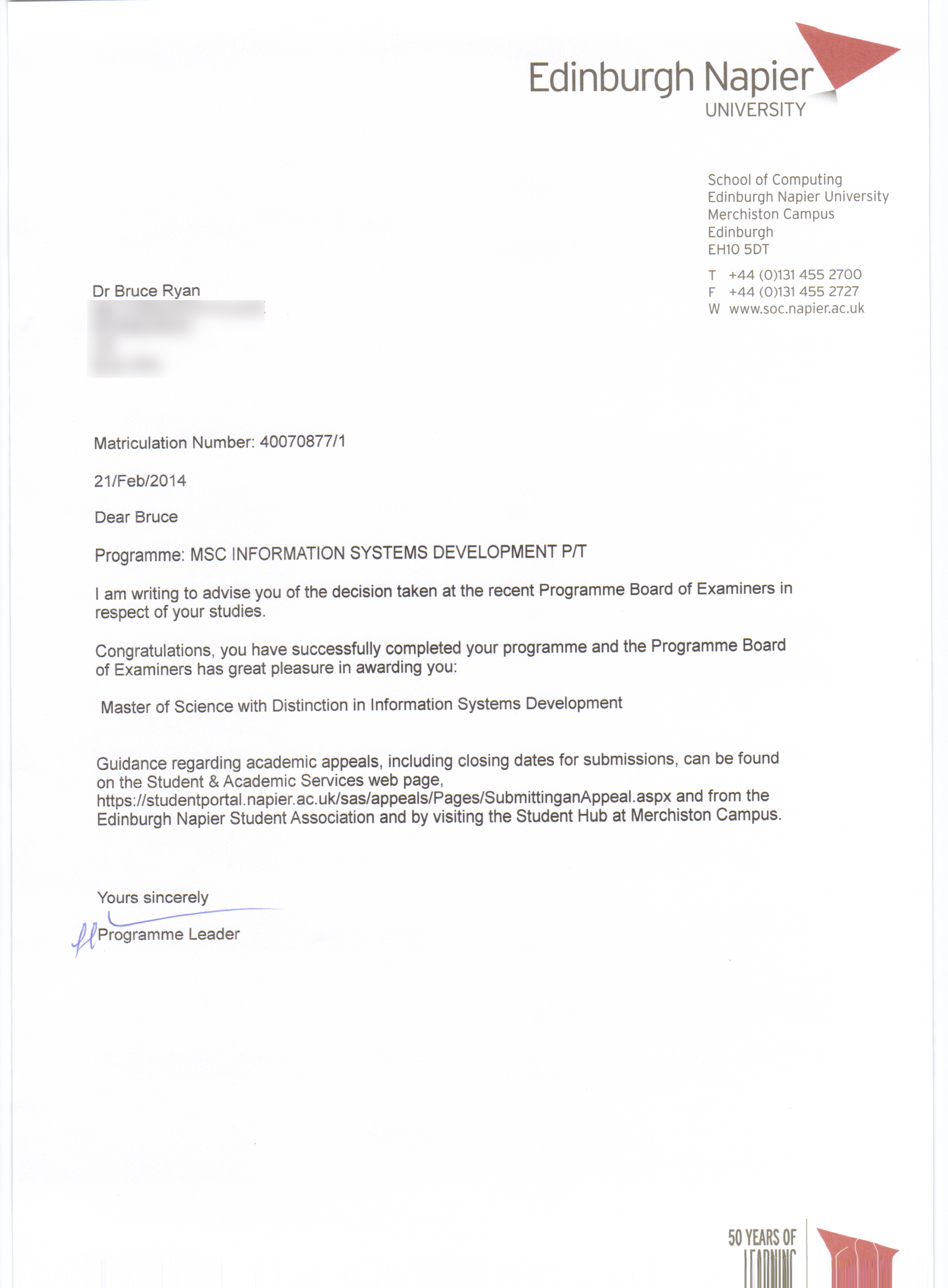
| When | Mood | Music |
| 2014-02-27 11:51:00 | pissed off | Dub side of the moon |
| When | Mood | Music |
| 2014-02-23 16:43:00 | caffeinated | Dub side of the moon – easy star all stars |
With friends for coffee this morning – they brought their newish black Labrador. Here’s the digital evidence:
| smiley | demonic | Heather |
 |
 |
 |
| When | Mood | Music |
| 2014-02-22 09:54:00 | pleased | Radio 4 |
Remember this? Well it seems my dissertation mark has been bumped up from D1 to D2. Based on these grade-bands and the grades below, here is my final info-graphic. Based on this, my final average mark is 84·5% – on the boundary between D2 and D3. It doesn’t include the infra-distinction mark for the web-enabled business module. If it did, my averages would be 83·25 and D2.
Big table of grades and module descriptions
| Year | Term | Module number and name | Credits | Grade |
| Notes | ||||
| 2011/2 | 1 | CSN11108: Computer Systems | 10 | D4 |
|
In this module you will appraise computer hardware, networks and operating systems with an emphasis on practical operating principles. You will learn about the key features of PC based computer systems and networks, including the structure and operation of local and wide-area networks. The operating systems element uses Windows to give a practical underpinning to the subject.
features of PC based systems: Motherboards, hub chips, processors, RAM and cache. Basic processor operation: the fetch execute cycle and interrupts. Principles of Operating systems: virtual memory and multitasking. Case study: the Windows operating system. Main features of Local area Networks and the Internet: Ethernet, wireless networks, the Internet Protocol. Introduction to some of the main Network devices, such as switches and routers.
On completion of this module, students will be able to:
|
||||
| 2011/2 | 1 | SET11101: Database Systems | 10 | D3 |
|
You will gain knowledge and understanding of database systems design, creation and usage. The database design life-cycle will be followed and the ISO standard query language SQL used to access databases. To be successful in this module you will need some background knowledge of computer systems.
Database architecture and functionality, data analysis and entity-relationship modelling Normalisation: 1NF, 2NF, 3NF and BCNF SQL and relational algebra. The role of a Database Administrator (DBA). Database models such as the hierarchical data model and the functional data model.
On completion of this module, students will be able to:
|
||||
| 2011/2 | 1 | SET11102: Software Development 1 | 20 | D4 |
|
In this module you will learn the basics of how to write software. This module on its own gives a good introduction to Software Engineering and can also be used as a first step before going on to more advanced software development modules.
Program Environment: Use of an interactive development environment. Basic Programming Skills: Variable declarations, printing to the screen, reading from the keyboard, simple arithmetic operations, sequence, selection and iteration, functional decomposition, arrays, simple GUI’s. Introduction to object-oriented programming. Program testing and documentation.
On completion of this module, students will be able to:
|
||||
| 2011/2 | 2 | INF11101: Web-enabled Business | 20 | P5 |
|
I took this module because I couldn’t decide between it and Software Development 2. So it was an extra module and I don’t count it towards my marks info graphic, even though it led to my current research interests, mostly because it would lower my average mark. In this module you will explore and evaluate current approaches to, benefits of and challenges to the delivery of integrated information services in a range of organisations. You will address the role of the World Wide Web (as part of the Internet) in delivering integrated information services in a range of organisations. You will explore and evaluate contemporary Web-based approaches to information integration, their benefits, and associated challenges. The module takes a managerial rather than technical viewpoint, although some familiarity with the Internet is assumed. An overview of Internet technologies and the issues in their use, including security. Business models and strategy for effective use of Internet technologies in organisations, including ethical, legal and regulatory frameworks Issues in effective e-business systems development. Role of individuals and sense-making in the effective use and re-use of information resources. Evaluation of the support to business processes offered by information handling systems and their role in facilitating effective decision-making. Analysis of the characteristics and roles of intranets, portals, enterprise content management systems (ECMSs), integrative middleware and other relevant systems.
On completion of this module, students will be able to:
|
||||
| 2011/2 | 2 | SET11103: Software Development 2 | 20 | D1 |
|
In this module you will build on existing Java software development skills to learn to design, develop and test object oriented applications using the Unified Modelling Language and Java. Object oriented programming is based on modelling real world objects in software by defining their attributes and behaviour.
Object-oriented design: identifying architectural relationships of associations and aggregations, recording results of a design, system building, reasoning about a design, development lifecycles. Documentation: Produce detailed user and technical documentation for programs. Design, implement, test and document a non-trivial software application. Save and retrieve data from sources external to Java. Develop interfaces to Java programs.
On completion of this module, students will be able to:
|
||||
| 2012/3 | 1 | SET11106: Information Systems Engineering | 20 | D4 |
|
In this module you will learn how information systems are developed. Included are requirements gathering and specification, database design, interaction design, process specification, system construction and testing. The emphasis is on Agile Application Development, with theory being illustrated throughout by practical use of a construction tool such as Microsoft Access for practicals and coursework.
Approach: Student experience from practical work will be backed by lectures which will present the theory. Theory: Business operation and information needs System types – single user, networked, distributed, web based, etc. Project overview, life cycles and methodologies. Requirements elicitation, modelling and specification. The Unified Modelling Language (UML). Basics of the design and specification of interactions, processes and database, Testing theory. Practical: Developing and assessing simple applications using menus, forms, subforms, tables, queries and some programming.
On completion of this module, students will be able to:
|
||||
| 2012/3 | 2 | INF11103: Management of Software Projects | 20 | D1 |
|
In this module you will address various approaches and concepts that ensure software development projects are correctly managed and successfully delivered. You will focus on management elements rather than on technical aspects of programming or systems design. Usually these “softer” managerial elements are the most crucial when it comes to successful delivery. Classes will include discussions led by practising industry experts and tutorials will be geared around practical elements of project management
Managing project start-up through project evaluation and project planning techniques. Comparative analysis of project management approaches and Bodies of Knowledge (BoK) applied to software development projects. The assessment of project risk management approaches and metrics for project monitoring and control. Analysis of software development process improvement approaches through software quality standards and maturity models. Evaluation of software development teams and group dynamics as key factors in the successful delivery of projects. Utilisation of a tailored project management methodology such as PRINCE2 to manage the delivery of an assessment instrument. Evaluation of procedural and technical approaches to project management in comparison with more adaptive and reflective approaches.
On completion of this module, students will be able to:
|
||||
| 2012/3 | 2 | SET11112: Web Design & Development | 20 | D3 |
|
This module will provide you with a detailed insight into the practical and theoretical aspects of modern web page design & development technologies. The theoretical side will cover such issues as emerging web techniques & technologies and the motivation behind such. The practical side will give the you hands-on experience of developing Web pages using these techniques & technologies.
Current ideas on web page design; Document Object Model (DOM); Document Type Definitions (DTD); web page construction using authoring tools such as Dreamweaver MX; XHTML coding; scripting using PHP and Javascript; database connectivity using PHP & mySQL; Cascading Style Sheets; XML; external & internal page validation
On completion of this module, students will be able to:
|
||||
| 2012/3 | 3 | SOC11101: Masters Dissertation | 60 | D2 |
|
In this 60 credit module you will take control of your studies to produce a substantial piece of focussed academic research. Success in the dissertation module indicates an ability to work independently, so you are expected to take the initiative and manage your own project. In effect, you are learning how to do research; a sort of apprenticeship to an experienced academic supervisor in some respects.
The work for this module comprises the completion of an individual research project. Each student is assigned a personal Supervisor, and an Internal Examiner who monitors progress and feedback, inputs advice, examines the dissertation and takes the lead at the viva. There are three preliminary deliverables prior to the submission of the final dissertation:
On successful completion of this module, students will be able to:
|
||||
a back-up of https://friends-ssct.org
wibbelwobble
Good governance and leadership
Participatory Budgeting for the Leith Neighbourhood Network
Maximising the impact and value of library and information science research
Leith Harbour and Newhaven Community Council
News, funding opportunities, and support from Research, Innovation & Enterprise
 Digital evidence that Bruce might have a life