casualty map

When Mood Music
2012-04-13 18:44:00 amused Who Needs Information – Roger Waters

The music was unintentional but is amusingly appropriate.

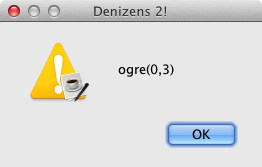
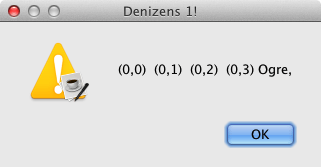
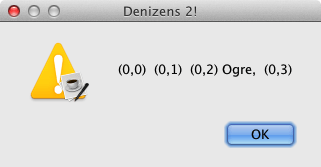
I can add a lot of creatures, move them all around and draw a textual ‘map’ of where they all are. Even better, it agrees with where the creatures themselves say they are!


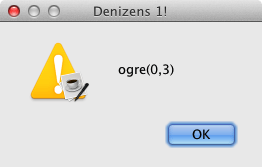
  • List of creatures and their individuate coordinates 1
  • Independently-generated map 1
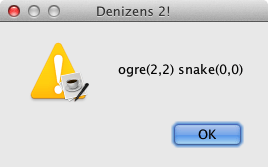
  • List of creatures and their individuate coordinates 2
  • Independently-generated map 2

The code to draw the map is horribly inefficient: for each grid-square in each row, each creature is asked ‘should you be added to the list of creatures for this grid-square?’. For a 4 by 4 swamp, each creature is interrogated mercilessly 16 times! I hope I can find a better way – maybe each creature could have a record of whether it’s been added to the map. But then it would need to be interrogated about this too!

If I was still working with grid-square objects, the code would have been ‘for each grid-square in each row, ‘give me a list of your contents’. But that approach didn’t work because of the difficulty of moving creatures.

Don’t count your chickens

When Mood Music
2012-04-13 15:05:00 awake White Noise – Stiff Little Fingers

And now

  1. The ogre is automatically created when the swamp is created. (There’s a boolean to record whether he’s present/alive. This will be useful in deciding whether the game should end.
  2. I can count the enemies currently threatening the ogre.

So:

  1. Create swamp and ogre
  2. Will an enemy arrive?
  3. Yes – here it is!
  4. Move the denizens:
  5. How many enemies currently threaten the ogre?
  6. Will another enemy arrive?
  7. Yes – here it is!
  8. Move the denizens:
  9. How many enemies currently threaten the ogre?

Now I can decide whether to have a battle and then work out the outcome.

shake it all about

When Mood Music
2012-04-13 14:18:00 amused Shake Your Body (Down To The Ground) (Full Intention Mix) – Full Intention

And now I have a method to move the creatures all about:

So:

  1. Add an ogre
  2. Will an enemy arrive?
  3. Yes – here it is!
  4. Keep those beasties rolling!


populating the swamp

When Mood Music
2012-04-13 13:57:00 awake the ping of incoming emails

More farting about later, I now have a Swamp class which has a collection to hold creatures. I can add an ogre to a random location, then decide (and for now, report) whether an enemy is to be added, then do any necessary enemy-population augmentation. (The enemies always arrive at (0,0)). I also have a method to report which creatures are currently in the swamp and where they are.

So:

  1. Add an ogre
  2. Will an enemy arrive?
  3. Yes – here it is!

On the next go:

  1. Add an ogre
  2. Will an enemy arrive?
  3. No – poor ogre is lonely (but he likes it that way).

success?

When Mood Music
2012-04-13 01:16:00 anxious the whirring of Iggy’s fans

Lots of anxiety today: the condition to ensure my creatures didn’t move illegally gave rise to infinite loop after infinite loop. Having 4 sorts of creatures represented as integer values within grid-squares gave rise to LOTS of duplicated code. Aaarrggh!

I’d resisted coding the creatures as objects, despite the opportunity to show I understood inheritance (creature = ogre or enemy; enemy = donkey, parrot or snake) because I feared that there would be a class between the creatures having coordinates and the grid-squares having coordinates. The creature would have to get its coordinates from the grid square in which it currently resided. But while moving, it would have no source of coordinates. Worse, how would a creature tell a grid-square “I’m moving in – increment your count of my type of creature!”?

It struck me today that there may be no need for formal coding of grid-squares. If the creatures know and can change their own co-ordinates on command, then so long as they can’t move past the upper or lower bounds of the swamp, then things should work – or so I thought.

On its own, code of the form works.

public static void move(int size, int Coord) {
double decider;
int limit = size – 1;

do {
decider = Math.random();
if (decider < 0.5) {
Coord = Coord – 1;
} //end if
else Coord = Coord + 1;
} while (Coord < 0 || Coord > limit);
} //end move

The while condition says ‘keep trying while the co-ordinate is negative or past the upper limit’.

But try as I might, putting this into the code for a creature didn’t work – in fact the IDE came perilously close to choking Iggy.

So I’m doing it in a klutzy, non-satisfactory way:

  • If the current coordinate is 0, it’s then either unchanged or increased by 1.
  • If the current coordinate > 0 and < limit, it’s then decreased by 1, unchanged or increased by 1.
  • If the current coordinate is at the upper limit, it’s then decreased by 1 or unchanged.

To make an actual move, I run through the above process twice, once for x-direction and once for y-direction.

To ensure there is some movement, I find the x-distance travelled and the y-distance travelled: if both of these are zero, a boolean is set to ‘false’. The ‘make a move’ code is wrapped in a do/while loop which forces the code to be repeated until the boolean becomes true.

So now I can add an ogre to my program at a random place and a random choice of enemy at coordinates (0,0). Tomorrow I aim to have the game mechanism set up: this starts by placing an ogre at random. The luser is asked if another turn should occur. (If not, the game will quit.) At the start of each turn, all creatures already present move, then there is a finite chance of a new enemy turing up at (0,0).

After that, it’s just a matter of being able to serialise the game state so it can be saved, creating a set of tests and drawing UML diagrams.

bah!

When Mood Music
2012-04-12 00:57:00 aggravated Stars and Stripes of Corruption – Dead Kennedys

Bah! It seems to be time to stop. I’ve got methods which **should** move the ogre and his enemies reliably but…
An ogre is placed at random:

A suitable number of enemies arrive in the left-most square:

He moves – but in this case he just disappears. I guess he’s escaping the bounds of a do-while loop!
.

Then the donkeys should move – but this method appears to have gone to Cupertino.

Time to sleep!

Denizens

When Mood Music
2012-04-11 21:49:00 blank Square Boxes – Roy Harper

I’ve got my demo Row program adding adding an Ogre at a random position and a random choice of (donkey, parrot or snake) at square (0,0).

I need to learn Swing to replace the poxy default Java icon with something nicer.

I want to tweak the code that lists the denizens of each grid-square so that trailing commas are eliminated but that can wait.

summary

When Mood Music
2012-04-11 18:40:00 content Space Shanty – Leftfield

I now have code for a grid-square class. Grid-square objects

  • know where they are
  • how many ogres, donkeys, parrots and snakes they contain (initially zero of each)
  • can increment and decrement the numbers of these creatures (and will sing out if the numbers ever become negative or if there is more than 1 ogre)
  • can report these numbers
  • can decide whether the ogre overwhelms the other creatures or vice versa (and will sing out if I try to have a battle involving zero ogres)

Now I have to construct a row as a collection of grid-squares and create methods to

  • add an ogre to a random square
  • add donkeys, parrots and snakes at random to the first square in the grid
  • move the denizens about at random
  • provoke fights between the ogre and the others in whatever grid-square he’s in.

Then I have to construct a swamp as a collection of rows and develop 2-D versions of the random-movement methods.

Poor ogre – no matter what, eventually he’s going to be brayed, squawked or venomed (or combinations thereof) out of existence.