| Year |
Term |
Module number and name |
Credits |
Grade |
| Notes |
| 2011/2 |
1 |
CSN11108: Computer Systems |
10 |
D4 |
|
In this module you will appraise computer hardware, networks and operating systems with an emphasis on practical operating principles. You will learn about the key features of PC based computer systems and networks, including the structure and operation of local and wide-area networks. The operating systems element uses Windows to give a practical underpinning to the subject.
features of PC based systems: Motherboards, hub chips, processors, RAM and cache. Basic processor operation: the fetch execute cycle and interrupts. Principles of Operating systems: virtual memory and multitasking. Case study: the Windows operating system. Main features of Local area Networks and the Internet: Ethernet, wireless networks, the Internet Protocol. Introduction to some of the main Network devices, such as switches and routers.
On completion of this module, students will be able to:
- LO1: Appraise the key features of PC based hardware architectures in order to be able to analyse PC requirements to produce specifications for PC based systems.
- LO2: Critically assess the principles of operating systems as used in PCs.
- LO3: Appreciates the main features of networks, both wired and wireless.
|
| 2011/2 |
1 |
SET11101: Database Systems |
10 |
D3 |
|
You will gain knowledge and understanding of database systems design, creation and usage. The database design life-cycle will be followed and the ISO standard query language SQL used to access databases. To be successful in this module you will need some background knowledge of computer systems.
Database architecture and functionality, data analysis and entity-relationship modelling Normalisation: 1NF, 2NF, 3NF and BCNF SQL and relational algebra. The role of a Database Administrator (DBA). Database models such as the hierarchical data model and the functional data model.
On completion of this module, students will be able to:
- LO1: Analyse and implement a relational database application
- LO2: Examine the elements of SQL and some proposed recent extensions with a set of relational database applications
- LO3: Critically appraise the role of a database and the functions which should be provided by a DBMS and the DBA
- LO4: Compare and contrast various database models such as the hierarchical data model and the functional data model
|
| 2011/2 |
1 |
SET11102: Software Development 1 |
20 |
D4 |
|
In this module you will learn the basics of how to write software. This module on its own gives a good introduction to Software Engineering and can also be used as a first step before going on to more advanced software development modules.
Program Environment: Use of an interactive development environment. Basic Programming Skills: Variable declarations, printing to the screen, reading from the keyboard, simple arithmetic operations, sequence, selection and iteration, functional decomposition, arrays, simple GUI’s. Introduction to object-oriented programming. Program testing and documentation.
On completion of this module, students will be able to:
- LO1: Use a modern interactive programming development environment.
- LO2: Make informed decisions in order to select and employ programming constructs in the development of Java applications using text interfaces and graphical user interfaces.
- LO3: Design and use suitable test cases for program testing.
- LO4: Produce appropriate program documentation.
- LO5: Demonstrate basic knowledge of object-oriented programming.
|
| 2011/2 |
2 |
INF11101: Web-enabled Business |
20 |
P5 |
I took this module because I couldn’t decide between it and Software Development 2. So it was an extra module and I don’t count it towards my marks info graphic, even though it led to my current research interests, mostly because it would lower my average mark.
In this module you will explore and evaluate current approaches to, benefits of and challenges to the delivery of integrated information services in a range of organisations. You will address the role of the World Wide Web (as part of the Internet) in delivering integrated information services in a range of organisations. You will explore and evaluate contemporary Web-based approaches to information integration, their benefits, and associated challenges. The module takes a managerial rather than technical viewpoint, although some familiarity with the Internet is assumed.
An overview of Internet technologies and the issues in their use, including security. Business models and strategy for effective use of Internet technologies in organisations, including ethical, legal and regulatory frameworks Issues in effective e-business systems development. Role of individuals and sense-making in the effective use and re-use of information resources. Evaluation of the support to business processes offered by information handling systems and their role in facilitating effective decision-making. Analysis of the characteristics and roles of intranets, portals, enterprise content management systems (ECMSs), integrative middleware and other relevant systems.
On completion of this module, students will be able to:
- LO1: Evaluate the concepts and applications which underpin the use of Internet technologies in organisations
- LO2: Assess the business, organisational and managerial implications of such technologies
- LO3: Critically assess current models of information behaviours and information metrics in organisations
- LO4: Synthesize solutions to information integration challenges in a range of organisations
- LO5: Present the output of independent and directed study in the form of a report
|
| 2011/2 |
2 |
SET11103: Software Development 2 |
20 |
D1 |
|
In this module you will build on existing Java software development skills to learn to design, develop and test object oriented applications using the Unified Modelling Language and Java. Object oriented programming is based on modelling real world objects in software by defining their attributes and behaviour.
Object-oriented design: identifying architectural relationships of associations and aggregations, recording results of a design, system building, reasoning about a design, development lifecycles. Documentation: Produce detailed user and technical documentation for programs. Design, implement, test and document a non-trivial software application. Save and retrieve data from sources external to Java. Develop interfaces to Java programs.
On completion of this module, students will be able to:
- LO1: Make informed decisions in order to select and use a range of object-oriented programming skills, techniques and practices
- LO2: Design, implement, test and document a significant piece of software
- LO3: Design and use advanced test cases throughout program development
- LO4: Provide a critical analysis of the software developed making informed judgements about the software’s completeness, extensibility and maintainability
|
| 2012/3 |
1 |
SET11106: Information Systems Engineering |
20 |
D4 |
|
In this module you will learn how information systems are developed. Included are requirements gathering and specification, database design, interaction design, process specification, system construction and testing. The emphasis is on Agile Application Development, with theory being illustrated throughout by practical use of a construction tool such as Microsoft Access for practicals and coursework.
Approach: Student experience from practical work will be backed by lectures which will present the theory. Theory: Business operation and information needs System types – single user, networked, distributed, web based, etc. Project overview, life cycles and methodologies. Requirements elicitation, modelling and specification. The Unified Modelling Language (UML). Basics of the design and specification of interactions, processes and database, Testing theory. Practical: Developing and assessing simple applications using menus, forms, subforms, tables, queries and some programming.
On completion of this module, students will be able to:
- LO1: Critically appraise the information needs of organisations
- LO2: Critically assess the concepts of development stages and methods
- LO3: Evaluate possible models, designs and specify elements of existing/proposed systems
- LO4: Construct and critically evaluate a system using system construction tool(s)
|
| 2012/3 |
2 |
INF11103: Management of Software Projects |
20 |
D1 |
|
In this module you will address various approaches and concepts that ensure software development projects are correctly managed and successfully delivered. You will focus on management elements rather than on technical aspects of programming or systems design. Usually these “softer” managerial elements are the most crucial when it comes to successful delivery. Classes will include discussions led by practising industry experts and tutorials will be geared around practical elements of project management
Managing project start-up through project evaluation and project planning techniques. Comparative analysis of project management approaches and Bodies of Knowledge (BoK) applied to software development projects. The assessment of project risk management approaches and metrics for project monitoring and control. Analysis of software development process improvement approaches through software quality standards and maturity models. Evaluation of software development teams and group dynamics as key factors in the successful delivery of projects. Utilisation of a tailored project management methodology such as PRINCE2 to manage the delivery of an assessment instrument. Evaluation of procedural and technical approaches to project management in comparison with more adaptive and reflective approaches.
On completion of this module, students will be able to:
- LO1: Critically evaluate project management planning techniques and project lifecycles.
- LO2: Analyse different project management approaches.
- LO3: Critically reflect on approaches to risk management and metrics for monitoring and control in Projects.
- LO4: Critically assess mechanisms for software development process improvement through an examination of software quality standards and maturity models.
- LO5: Evaluate human factors and group dynamics in project environments.
- LO6: Research and analyse multidisciplinary approaches to project management beyond technical and procedural approaches.
|
| 2012/3 |
2 |
SET11112: Web Design & Development |
20 |
D3 |
|
This module will provide you with a detailed insight into the practical and theoretical aspects of modern web page design & development technologies. The theoretical side will cover such issues as emerging web techniques & technologies and the motivation behind such. The practical side will give the you hands-on experience of developing Web pages using these techniques & technologies.
Current ideas on web page design; Document Object Model (DOM); Document Type Definitions (DTD); web page construction using authoring tools such as Dreamweaver MX; XHTML coding; scripting using PHP and Javascript; database connectivity using PHP & mySQL; Cascading Style Sheets; XML; external & internal page validation
On completion of this module, students will be able to:
- LO1: Critically evaluate the current standards & technologies used to develop WWW systems
- LO2: Critically analyse the motivation behind trends in modern web technologies and identify emerging issues.
- LO3: Design, develop and evaluate a suite of web pages using appropriate web technologies
|
| 2012/3 |
3 |
SOC11101: Masters Dissertation |
60 |
D2 |
|
In this 60 credit module you will take control of your studies to produce a substantial piece of focussed academic research. Success in the dissertation module indicates an ability to work independently, so you are expected to take the initiative and manage your own project. In effect, you are learning how to do research; a sort of apprenticeship to an experienced academic supervisor in some respects.
The work for this module comprises the completion of an individual research project. Each student is assigned a personal Supervisor, and an Internal Examiner who monitors progress and feedback, inputs advice, examines the dissertation and takes the lead at the viva. There are three preliminary deliverables prior to the submission of the final dissertation:
- Project proposal (there is a formal approval process by module leader before projects start);
- Initial Report;
- Outline dissertation.
On successful completion of this module, students will be able to:
- LO1: Conduct a literature search using an appropriate range of information sources and produce a critical review of the findings.
- LO2: Demonstrate professional competence by sound project management and a) by applying appropriate theoretical and practical computing concepts and techniques to a non-trivial problem, or b) by undertaking an approved project of equivalent standard.
- LO3: Show a capacity for self-appraisal by analysing the strengths and weakness of the project outcomes with reference to the initial objectives and to the work of others.
- LO4: Provide evidence of the foregoing in the form of a dissertation which complies with the requirements of the School of Computing both in style and content.
- LO5: Defend the work orally at a viva voce examination.
|


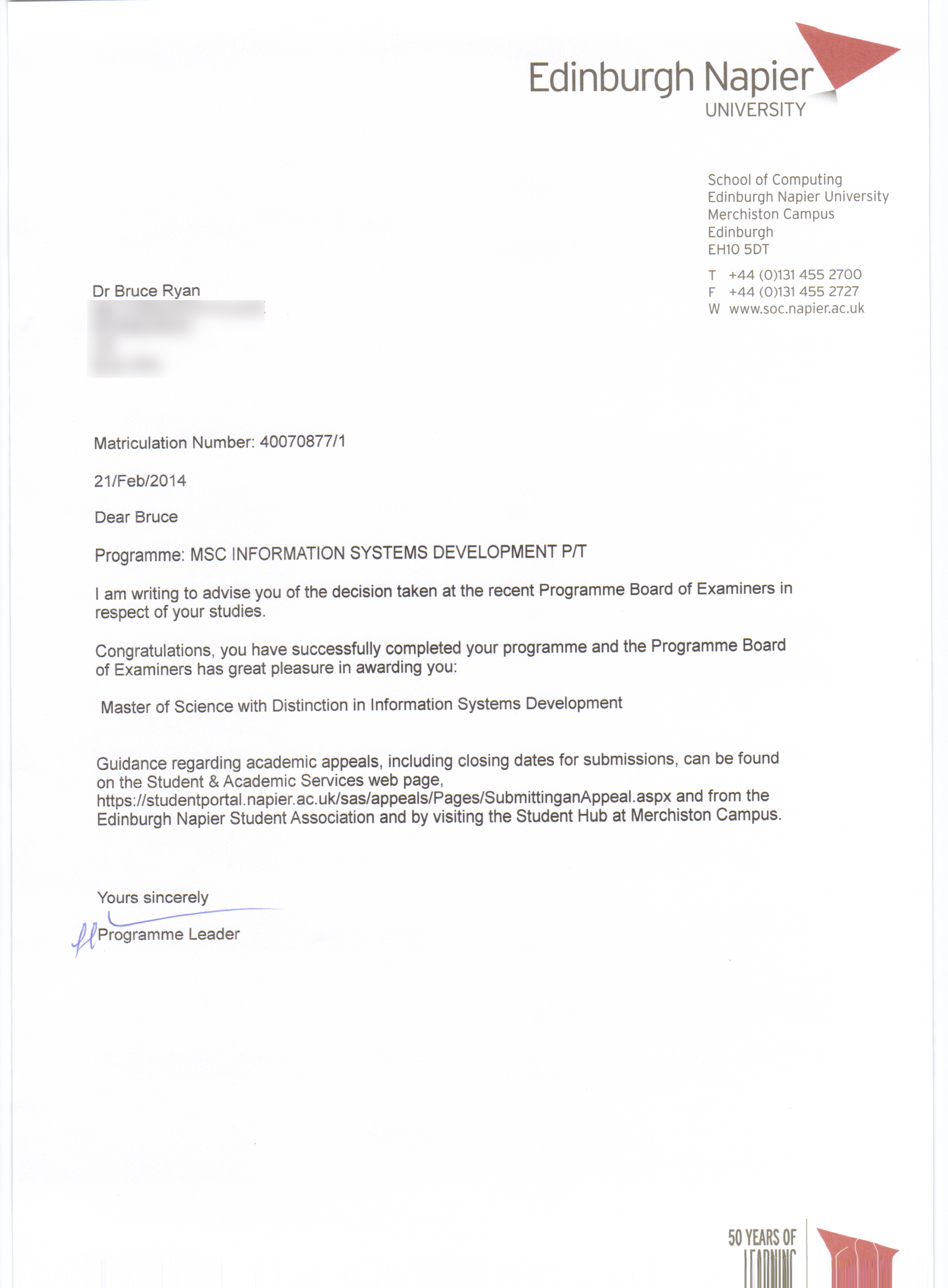



 Digital evidence that Bruce might have a life